Piastri's Australian GP Crash: The Unforeseen Power Spike & Kerb Conundrum
The roar of Formula 1 engines typically signals the start of high-octane racing, but for Oscar Piastri at his home Australian Grand Prix, drama struck even before the lights went out. A promising qualifying performance, securing a fifth-place grid slot, dissolved into a cloud of disappointment following a dramatic pre-race crash. This wasn't merely a lapse in judgment; it was a complex interplay of unexpected technological anomalies and track specifics, leaving the McLaren driver bewildered and his home crowd heartbroken. The incident underscored the razor-thin margins in F1, where even the slightest deviation from the expected can have catastrophic consequences, dramatically altering the course of a driver's weekend.
Deconstructing the Pre-Race Calamity: A Combination of Bad Factors
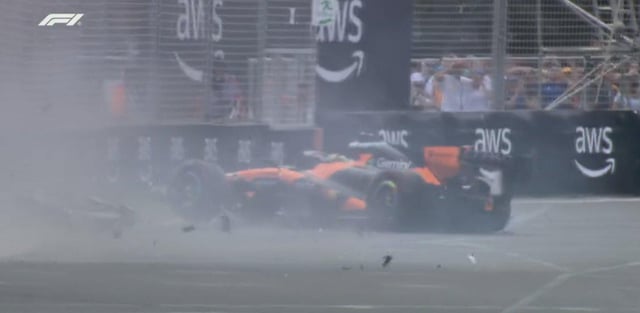
The scene was Melbourne’s Albert Park, a circuit renowned for its challenging street-circuit characteristics. Approximately 40 minutes before the race was set to begin, Piastri embarked on his routine reconnaissance laps to the grid, a final check for car and driver. Exiting the sweeping Turn 4 left-hander, his McLaren MCL40 suddenly broke traction, spinning out of control and careening into the concrete wall on the driver's left. The impact was significant, inflicting terminal damage to the front-end, particularly the right-front wheel and suspension. Piastri, though physically unharmed, was left with a wrecked car and a heart full of dejection, forced to watch the race from the sidelines.
In the aftermath, a visibly disappointed Piastri shared his initial thoughts, describing the moment as a “combination of bad factors.” He expressed shock and surprise at the sudden loss of control, remarking, “I was backwards before I'd even really had a chance to react.” This wasn't a slow, controllable slide; it was an instantaneous and violent snap, indicative of an external, unforeseen variable at play in the piastri accident course.
The Unexpected Power Surge: A 100 kW Jolt
At the core of Piastri's explanation was an astonishing revelation: an unexpected and substantial power spike. “Essentially I had 100 kW more power than I’ve had the whole weekend, at the point that I shifted,” Piastri explained. To put this in perspective, 100 kilowatts is roughly equivalent to 134 horsepower — a massive, unplanned increase in power delivery, particularly at a critical moment of shifting gears. Modern F1 hybrid power units are incredibly complex, blending internal combustion with powerful electric motors. While engineered for precision, such an unpredictable surge points to a momentary malfunction or an unforeseen interaction within the intricate energy recovery systems (ERS) and engine mapping.
This power spike, occurring precisely when Piastri was transitioning gears, induced immediate wheelspin. The sophisticated traction control systems, usually adept at managing such scenarios, were overwhelmed by the sudden and uncommanded burst of energy. Piastri noted that “everything kind of reacted the way it should within the rules,” suggesting that while the system tried to cope, the sheer magnitude of the power delivery was beyond its immediate corrective capacity. This incident highlights the razor's edge on which F1 engineers operate, constantly balancing maximum performance with absolute reliability, and the inherent risks when these complex systems deviate from their programmed parameters. The unexpected power surge directly influenced the piastri accident course, turning a routine lap into a disaster.
The Kerb and Cold Tyres: Amplifying the Impact
While the power spike was the primary catalyst, Piastri was also quick to acknowledge his own contribution to the incident. “I think using… I got on the kerb a little bit,” he admitted. Negotiating kerbs is a fundamental part of F1 driving, allowing drivers to optimize their racing lines and shave fractions of a second. However, on reconnaissance laps, tyres are often not yet up to optimal operating temperature, meaning less grip. Piastri also confirmed he had used that specific exit kerb every lap of the weekend without issue, but the combination of cold tyres, being on the kerb, and the sudden 100 kW power surge proved to be a lethal cocktail.
The kerb itself, while designed to be part of the track, can be a treacherous surface, especially when approached with excessive power and insufficient tyre temperature. The grip level on a kerb is inherently lower and less predictable than on the asphalt, making it prone to causing wheelspin when power is aggressively applied. When the unexpected power surge hit, Piastri was already in a compromised position — cold tyres on a kerb — amplifying the effect of the wheelspin and making recovery impossible. This synergy of factors illustrates the intricate dance between driver input, vehicle dynamics, and track conditions that defines Formula 1, and how quickly it can unravel.
Lessons Learned: Beyond the Wheelspin and Disappointment
Piastri's Australian GP crash serves as a stark reminder of the unforgiving nature of Formula 1. For a driver at his home race, the disappointment was profound. “It’s a shame. Things like that shouldn’t be happening anywhere, especially at my home race. It’s obviously even more disappointing,” he lamented. This sentiment resonates deeply within the sport, as such fundamental mechanical surprises are rare and deeply frustrating for all involved. The incident meant McLaren had only Lando Norris competing, highlighting the immediate team-wide impact of such an unforeseen technical glitch.
Implications for Teams and Drivers
For McLaren, the incident undoubtedly triggered a thorough investigation. Data analysis from the car's telemetry will be paramount in understanding the precise cause of the power spike and ensuring it doesn't reoccur. This includes scrutinizing engine mappings, ERS deployment strategies, and sensor data. Such incidents underscore the constant development battle in F1, where pushing performance envelopes must always be balanced with robust reliability and safety protocols.
From a driver's perspective, while Piastri acknowledged his part, the “shock and surprise” of such an uncommanded power delivery emphasizes how drivers are at the mercy of their highly complex machinery. It reinforces the notion that even the best drivers can be passengers when technology throws an unexpected curveball. The incident also drew parallels to Kimi Antonelli's crash in FP3, where the Italian also lost control over kerbs after accelerating, hinting at potential broader characteristics of the current-generation F1 cars and their aggressive torque delivery, especially over bumps or compromised surfaces. Teams continuously gather data from these incidents to refine their car setups, software algorithms, and driver coaching, all aimed at enhancing control and mitigating risk on the piastri accident course and beyond.
Conclusion: A Relentless Pursuit of Perfection
Oscar Piastri's pre-race crash at the Australian Grand Prix was a cruel twist of fate, a confluence of a significant, unexpected power spike and compromised grip on a kerb with cold tyres. It was a stark demonstration that even in the most technologically advanced sport, unforeseen variables can emerge, instantly turning promise into despair. While deeply disappointing for Piastri and his home fans, the incident will serve as a valuable learning experience for McLaren and the broader F1 community. Every such event leads to deeper analysis, refinement of systems, and ultimately, an even greater understanding of the limits of performance and control. The relentless pursuit of perfection in Formula 1 means continually pushing boundaries, but also meticulously learning from every misstep, ensuring safety and reliability remain paramount as drivers navigate the ever-challenging piastri accident course of competition.